
• 0 Posts
  • 19 Comments
Joined 3 months ago
cake
Cake day: January 1st, 2026

help-circle

  • The US federal courts had an interesting opinion there: parents may always allow their children to access protected speech. Even with sex-related materials, the Supreme Court has stated

    the prohibition against sales to minors does not bar parents who so desire from purchasing the magazines for their children.

    They regarded as constitutionally defective laws that impose a single standard of public morality. Instead, they’d allow laws that “support the right of parents to deal with the morals of their children as they see fit”. Laws that take away parental control are also impermissible.

    “It is cardinal with us that the custody, care and nurture of the child reside first in the parents, whose primary function and freedom include preparation for obligations the state can neither supply nor hinder.” Prince v. Massachusetts, supra, at 166.

    In another decision, they regard & defend parental responsibility & discretion in leaving access open to children, and they find measures “enterprising and disobedient” children can circumvent preferable over unacceptable alternatives.

    The Commonwealth argues that central blocking would not fulfill the state’s compelling interest as effectively as the access number does because minors with phone lines could request unblocking or could gain access to unblocked phones. It also argues that a parent who chooses to unblock the home’s phone to gain access to sexually explicit material for himself or herself thereby places dial-a-porn phone service within the reach of minors with access to that phone. In this respect, the decision a parent must make is comparable to whether to keep sexually explicit books on the shelf or subscribe to adult magazines. No constitutional principle is implicated. The responsibility for making such choices is where our society has traditionally placed it — on the shoulders of the parent. See Bolger v. Youngs Drug Products Corp., 463 U.S. 60, 73-74, 103 S.Ct. 2875, 2883-84, 77 L.Ed.2d 469 (1983) (parental discretion controlling access to unsolicited contraceptive advertisements in the home is the preferred method of dealing with such material).

    Even with parental control, the Commonwealth is undoubtedly correct that there will be some minors who will find access to unblocked phones if they are determined to do so. As the Supreme Court noted in Sable, “[i]t may well be that there is no fail-safe method of guaranteeing that never will a minor be able to access the dial-a-porn system.” 109 S.Ct. at 2838. Nonetheless, the Court did not deem the desire to prevent “a few of the most enterprising and disobedient young people,” id., from securing access to such messages to be adequate justification for a statutory provision that had “the invalid effect of limiting the content of adult telephone conversations to that which is suitable for children.” Id. at 2839. We hold that because the means used, requirement of an access code, substantially burdens the First Amendment right of adults to access to protected materials and is not the least restrictive alternative to achieve the compelling end sought, the statute cannot survive the constitutional attack.

    So, according to them, presenting such content to children ought to be left up to their parents, and laws shouldn’t infringe on their right to do that.




  • Wrong technical solution to a made up problem.

    Governments have commissioned enough studies to know that education, training, and parental controls filtering content at the receiving end are more effective & less infringing of civil rights than laws imposing restrictions & penalties on website operators to comply with online age verification. Laws could instead allocate resources to promote the former in a major way, setup independent evaluations reporting the effectiveness of child protection technologies to the public, promote standards & the development of better standards in the industry. Laws of the latter kind simply aren’t needed & also suffer technical defects.

    The most fatal technical defect is they lack enforceability on websites outside their jurisdiction. They’re limited to HTTP (or successor). They practically rule out dynamic content (chat, fora) for minors unless that content is dynamically prescreened. Parental control filters lack all these defects, and they don’t adversely impact privacy, fundamental rights, and law enforcement.

    Governments know better & choose worse, because it’s not about promoting the public good, it’s about imposing control.


  • Not even then: people are fallible, partners can cheat, and admitting that creates a compromising predicament for the person least likely to admit it. It’s in everyone’s interest of health to simply take all sensible precautions regardless. Only reason not to is when you want to conceive.


  • it’s mostly bullies and wannabe bullies. And that most people who claim they are for social justice, aren’t. They are just for screaming and belittling other people who are different than them.’

    the people doing the saying are very rarely doing anything to help the people they ‘advocate’ for so much as they are using them as a soapbox to grandstand about how they are ‘good’ and anyone who isn’t as ‘concerned’ as they are is ‘bad’.

    that’s lemmy in a nutshell

    even when they can do something purely through online expression like fix an inaccessible post, they’ll often still not do it: they’ll argue over it, offer nonexcuses (eg, their shitty lemmy app lacks basic features available from the website to edit posts & provide text alternatives), not fix their post, keep posting inaccessible content. these are the same people blasting each other about leftist causes, which sometimes ironically include accessibility.

    they’re social justice imposters


  • Yeah, inceldom has coopted the word

    Only if we let them, and anyone who does is an incompetent advocate choosing to let sexists decide the meaning of words for everyone else when everyone else has at least as much power to do otherwise. It’s complacent cooperation with the enemy that purports ethical superiority while being the opposite.

    Older activists who understood the pitfalls of establishing their own stigmatization in the language at least had the sense not to cooperate with their enemies. They’d more creatively reappropriate or reclaim words or embrace them as terms of pride. That lesson seems lost here.


  • Someone who subscribes to the pretentious “punch down” concept & seems so full of themselves they toss around assumptions of “bigotry”, “racism”, “sexism”, “anti-lgbtq+phobia” on the thinnest of evidence perhaps out of insecurity. Basically, anyone who says things that are a bit sanctimonious & haughty rather than cool & thoughtful possibly because they didn’t get enough hugs growing up or maybe too many.


  • Y’all have heard of the Nazi Bar problem, right?

    Bullshit genetic or reductio ad hitlerum fallacy. Carried to its logical conclusion, anything tainted by Nazis (eg, the universe) is a Nazi bar. Have you considered finding yourself another universe to inhabit, since this one is irredeemably tainted? While we may argue the universe is far too vast to be a “Nazi bar”, so is the internet or any “platform”.

    Worse, censoring ideas gives them covert power. It doesn’t discredit them or strip them of power like challenging them in a public forum could. It’s also a disservice to better ideas

    • it withholds opportunities for people to become competent enough advocates to discredit bad ideas
    • instead of deradicalize opponents, it drives their discussion elsewhere: they continue to radicalize & grow opposition unchallenged.

    Censorship is incompetent advocacy: it mistakes suppressing the expression of bad ideas for effective advocacy that directly discredits bad ideas, develops intellectual growth, and steers toward better ideas.

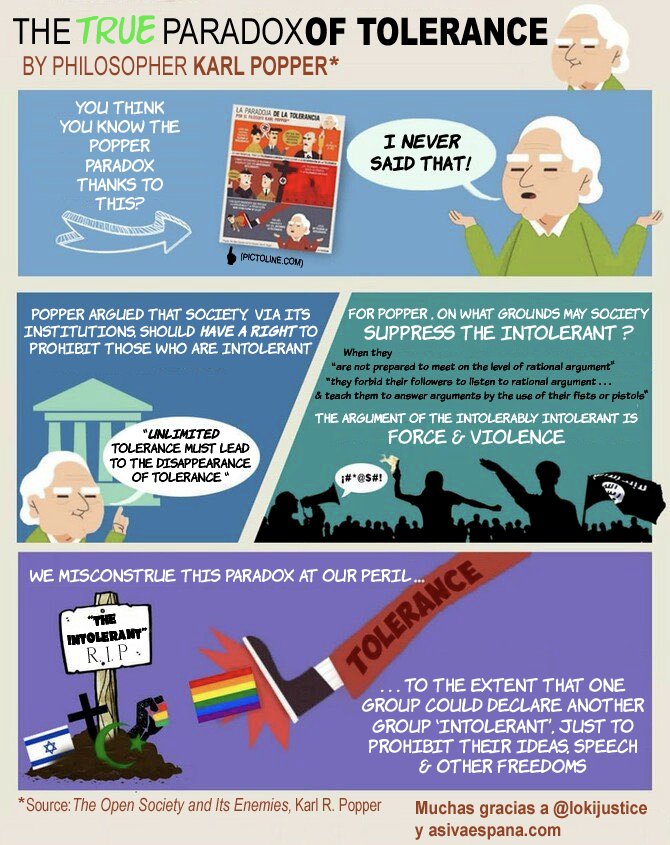
    Paradox of intolerance?

    The bogus social media version subverting the original message or the real one?

    text alternative

    The True Paradox of Tolerance

    By philosopher Karl Popper[1]

    You think you know the Popper Paradox thanks to this? (👉 comic from pictoline.com)

    Karl Popper: I never said that!

    Popper argued that society via its institutions should have a right to prohibit those who are intolerant.

    Karl Popper: Unlimited tolerance must lead to the disappearance of tolerance.

    For Popper, on what grounds may society suppress the intolerant? When they “are not prepared to meet on the level of rational argument” “they forbid their followers to listen to rational argument … & teach them to answer arguments by the use of their fists or pistols”. The argument of the intolerably intolerant is force & violence.

    We misconstrue this paradox at our peril … to the extent that one group could declare another group ‘intolerant’ just to prohibit their ideas, speech & other freedoms.

    Grave sign: “The Intolerant” RIP
    Underneath it lies a pile of symbols for Judaism, Christianity, Islam, Black power. A leg labeled tolerance kicks the Gay Pride symbol into the pile.

    Muchas gracias a @lokijustice y asivaespana.com

    Karl Popper opposed censorship/argued for free inquiry & open discourse.

    I do not imply, for instance, that we should always suppress the utterance of intolerant philosophies; as long as we can counter them by rational argument and keep them in check by public opinion, suppression would certainly be most unwise.

    Censorship (or willfully blinding ourselves to information) plays no part in suppressing authoritarianism.

    Only cowards fear words. Words are not the danger. It’s the dangerous people whose words we fail to discredit.


    1. Source: The Open Society and Its Enemies, Karl R. Popper ↩︎