

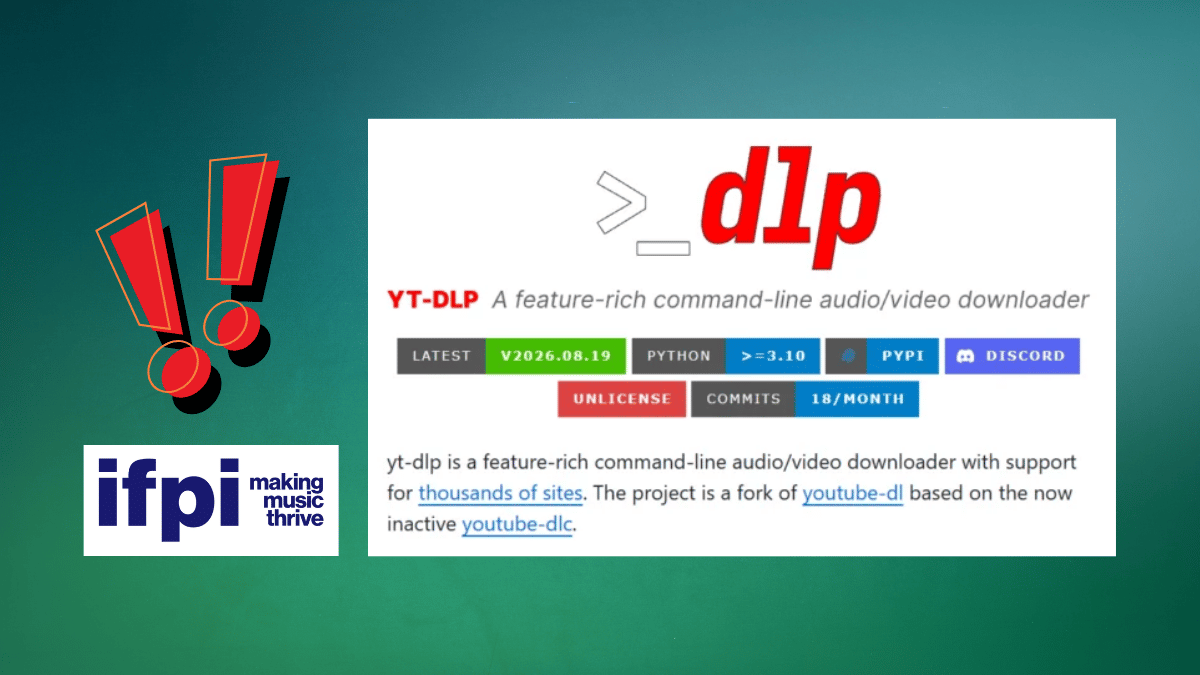
yt-dlp has over 195,000 stars on GitHub, supports thousands of platforms, and is actively maintained by a global developer community. Unfortunately, the IFPI would like to see it on the EU’s piracy watchlist.
Just so you know, the International Federation of the Phonographic Industry (IFPI) represents around 8,000 music labels across 70 countries.
In its submission to the EU’s Counterfeit and Piracy Watch List consultation, the group calls yt-dlp “a major problem for the music industry” and names four of its maintainers by their GitHub handles.
A Piracy Watch List?
Run by the European Commission’s Directorate-General for Trade and Economic Security, the Watch List identifies online services and physical marketplaces outside the EU reported to engage in or facilitate copyright infringement.
While it sounds serious, the undertaking isn’t meant to gather legal findings and does not mandate any form of direct action. It’s closer to a naming exercise intended to pressure operators and governments outside the EU into addressing the identified services.
The 2027 edition is being compiled from submissions received through September 2026, with the final list expected in Q2 2027. What does their submission say?
IFPI’s submission covers a wide range of copyright enforcement concerns, from AI music generators and cyberlockers to streaming fraud services and domain registrars. yt-dlp appears under the “stream ripping” section, grouped with commercial websites like Y2mate and Savefrom.
They describe the tool as an application that retrieves content by parsing web page data and interacting with platform playback endpoints, with GitHub serving as the primary delivery method for its source code, pre-compiled binaries, and installation instructions.
IFPI names four of the project’s maintainers by their GitHub handles: pukkandan, who founded the project and led it between 2021 and 2024, and some core maintainers mentioned in the project’s Maintainers.md file, like coletdjnz, bashonly, and Grub4K.
The same submission also flags X, Discord, Telegram, and Vimeo as platforms facilitating copyright infringement at scale.
It’s a tool, not a service
The Watch List, as described by the European Commission, targets online service providers and physical marketplaces located outside the EU. yt-dlp fits neither description in any conventional sense.
IFPI acknowledges this by noting that the project’s open source nature, its Unlicense licensing, and an extensive international developer community make it “difficult to contain and/or remove.”
From their point of view, there’s no central domain to block, no payment processor to cut off, and no hosting provider to strongarm into complying with a takedown request.
The source code is distributed globally and can be compiled by anyone with the skills to do so. But that doesn’t mean yt-dlp is a piracy platform.
It’s a command-line tool for downloading audio and video content, and categorizing it alongside dedicated ripping or piracy websites conflates a general-purpose downloader with services whose primary purpose is facilitating unauthorized copying. Closing thoughts
The Watch List has been used in connection with enforcement against commercial stream-ripping platforms before.
Y2mate.com and eleven other stream-ripping sites were shut down in Vietnam in 2025, and Y2mate had previously appeared on the list.
Before that, in 2024, a German court held the host provider for youtube-dl.org liable in connection with facilitating circumvention. This shows that grouping an open source command-line tool with those commercial services in the same breath does not, by itself, make the tool one of those.
With that logic, any web browser is a piracy tool. Because it lets you download and upload illegal files on illegal websites.
Any operating system is also a piracy tool because it let you keep pirated materia on it
Any HDD/SDD as well. They really want you to use a device that can only connect to the cloud and is basically useless without it.
Finland has actually had an extra tax on all recording medias, since VHS era, because they can be used for piracy. Bullshit of the purest kind.
millä nimellä kyseisestä verosta löytyy tietoa? En oo kuullut tuosta aiemmin
Se oli muistaakseni joku arvonlisäveron tyyppinen, ja kuului kasettien, CD-levyjen ja muiden tallennesmedioiden hintaan. En muista oliko sille jotain nimeä, ja ei mitään tietoa jos se on vielä voimassa.
Aiemmalta nimeltä kasettimaksu. Nykyään Yksityisen kopioinnin hyvitysmaksu. Vuoden 2016 jälkeen sitä ei enää lisätty hintoihin, vaan tekijänoikeusjärjestöt saa vapaasti imutella valtionbudjetista mututuntumalla. Lopputulos sama. Nykyään vähemmän perustuu todelliseen myyntiin. Aikoinaan lobbareiden riemuvoitto. Syy muutokseen oli vähän aikaisemmin voimaantullut tekijänoikeuslain muutos “Lex Karpela”. Jonka entinen missi ja silloin Sauli Niinistön kanssa sängyn jakanut kansanedustaja Tanja Kanja puski sen väkisin läpi eduskunnasta.
Even a cámara, you are violate the copyright when you make a photo from the iluminated Eiffel Tower by night or some historic buildings and use it in a publication. Cpyright yes, but in the way it make sense.
Not entirely true. You only need to ask for the permission if you want to use the photo commercially:
https://www.toureiffel.paris/en/business/use-image-of-eiffel-tower
Yes, private use is always legal, copyright is this, that in copyrighted content you need an permission and you have to pay if you want publicate it, like for the Eiffel Tower, there you need the permission of the company and you have to pay money for it. Same for the Eiffel Tower by Night or an downloaded Video. The exception are only contents without copyright (eg. CC, GPL licenses) like images, animations, music and videos from eg. Pixabay, which are all free to download and use even for commercial uses.
This copyright laws are also the cause that a lot of cinemas have closed, because they had to pay thousends of € for the right to project a movie in public. In times of VHS tapes, I had a friend which had a franchise of an Blockbuster shop, he had to pay several 100 bucks for every tape, to have the right to rent it to the people.
Copyright is big business, but for the industry and big companies, less for the authors, which mostly only receive some % of the money. Reason because artists prefer to use eg. Bandcamp, where they can sell directly their work, or to do it in their concerts, selling USB and CD, showing this way the middlefinger to these companies.
Media content with more than 70 years is mostly public domain and free to use, with some exceptions, like Chaplin movies which still have copyright by the Chaplin family.
Which color would that be?
Don’t give them any ideas
I’d say it’s more about the ease of use that it’s targeted. The average person is not getting a permanent mp3 or mp4 of a video by watching YouTube.
If they were to target anything it would be browser based extensions that allow that easily with a download button. Which are basically using the same routes that yt-dlp is using and putting a UI element for it.
I know. From the perspective of you and I it’s silly to target some specific popular method because there is no logic to do so. The logic they are using isn’t in the tool and how it’s made. The logic is just targeting something that’s popular. Rather than admit that the economic systems that rely on private property and scarcity are just fundamentally incompatible with digital content.
We’ve lived with an outdated economic system of incentives that should have died when the Internet was born. At least for digital content. This is just another denial of that contradiction. It doesn’t have to have a logical reason for it. It’s been illogical since the start.
Ease of use isn’t illegal. My point was that yt-dlp or any other tool isn’t just a piracy tool, because it is possible to do piracy stuff. It’s similar why emulators aren’t piracy tools. yt-dlp does nothing that is against the law, therefore calling it piracy tool is a bit of stretch. Any generalized tool that lets you download files from the internet and are easy would be a piracy tool with such definition. But the tool isn’t specifically crafted, nor marketed as a piracy tool (which is important in such a discussion).
I don’t disagree. I think what I’m trying to say is that you are applying rationality and consistency behind “what is legal” and how that is determined. You’re applying that reason to the way laws are created or interpreted.
But, “what is legal” is not rational or consistent in reality. What is legal or illegal is primarily determined by maintaining the interests and structures of existing economic systems. Systems that are built upon maintaining profits.
I’m not disagreeing with your reasoning. I’m saying that your rational thinking is not being applied by the systems that decide what is legal or what is illegal. The primary logic that is being applied is “is this hurting profits?”. And if the answer to that question is “yes” then these systems will create laws and classifications that are irrational and filled with contradictions; in order to protect those profits.